
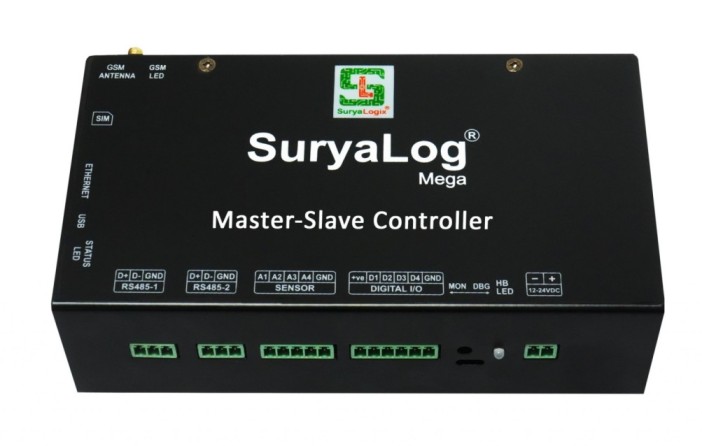
Master - Slave Controller
Enables centralized monitoring & controlling for multiple locations
What is Master Slave Controller?
For Solar/Hybrid Power Plants installed across multiple buildings and wings, the SuryaLog Master-Slave Communication system ensures seamless data management. By installing multiple SuryaLog Devices, one acts as the Master Device, while others function as Slave or Sub-Master Devices. The Master Device communicates with Slave Devices in each wing, enabling centralized monitoring of wing-wise energy data.
SuryaLog supports two Master-Slave communication types:
✔ Wired: Uses LAN, PLCC, and RS-485 for stable connectivity.
✔ Wireless: Utilizes LoRa Technology for long-range, interference-free data transmission.
Additionally, a Fail-Safe Mode ensures uninterrupted operation in case of connectivity failure with the Master Device, enhancing system reliability. Optimize your solar plant monitoring with SuryaLog’s advanced Master-Slave Communication for efficient and centralized data access.
Specifications & Features
- Fail Safe Mode in case of failure
- Building/ Wing wise management
- WLAN, Wireless & OFC
- Multiple DG interfacing
Frequently Asked Questions (FAQs) About Master Slave Controller
A master-slave controller connects multiple solar devices or buildings to one central master. It enables centralized monitoring, communication, and control.
The master collects data from slave devices and sends control commands when required. Communication can be wired or wireless.
The number depends on the communication protocol, network design, and project requirements. SuryaLog can be configured according to plant size.
Slave devices installed at different buildings communicate with one central master controller. This provides centralized monitoring from a common platform.
Yes, master-slave architecture can integrate Zero Export and PV-DG control. It enables coordinated monitoring and control across multiple plant sections.
A master-slave controller handles device communication and coordinated control. SCADA provides visualization, alarms, historical data, and plant-level supervision.
Wired communication offers stable connectivity, while wireless reduces cabling requirements. The best option depends on plant layout and site conditions.
Cost depends on the number of buildings, devices, communication type, and integration requirements. A site assessment is required for accurate pricing.