
- November 14, 2026
Rain Gauge Working Principle: Types, Rainfall Measurement & Applications
Rainfall plays an important role in weather conditions, agriculture, water management, and solar power plant operations. Accurate rainfall measurement provides valuable environmental data for monitoring weather patterns and planning maintenance activities. A rain gauge sensor measures the amount of rainfall received at a specific location over a defined period. In modern weather monitoring systems, these sensors collect precipitation data automatically and transmit it to data loggers for continuous recording.
The rain gauge working principle varies depending on the measurement technology, with tipping bucket, weighing bucket, and other designs used for different monitoring requirements.
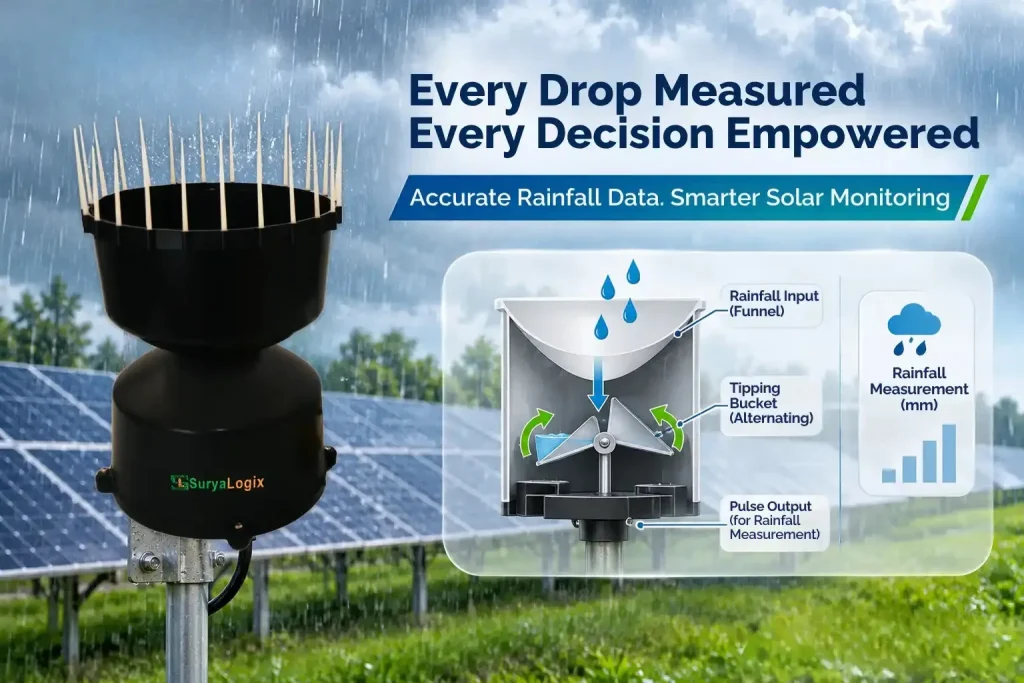
What Is a Rain Gauge Sensor?
A rain gauge is a meteorological instrument used to measure precipitation, generally expressed in millimetres (mm). One millimetre of rainfall represents one litre of water distributed uniformly over one square metre. A conventional rain gauge requires manual readings, while an automatic rainfall sensor generates electronic measurements that can be recorded through a data logger. Rain gauge sensors are widely used in automatic weather stations, environmental monitoring systems, agriculture, and solar power plants where continuous rainfall records are required.
How Does a Rain Gauge Work?
The basic principle of a rain gauge involves collecting precipitation over a known surface area and measuring the quantity received.In manual instruments, collected rainwater is measured directly. Automatic rain gauges use mechanical or electronic methods to convert rainfall into measurable signals.The tipping bucket rain gauge is one of the commonly used automatic instruments because it can generate electronic pulses corresponding to measured rainfall.
Tipping Bucket Rain Gauge Working Principle
A tipping bucket rain gauge consists of a collecting funnel, two calibrated buckets, a pivoting mechanism, and a sensor that detects bucket movement.
The measurement process works as follows:
- Rainwater collection: Rain enters the collecting funnel and flows toward the measuring mechanism.
- Bucket filling: Water accumulates in one of the two calibrated buckets.
- Tipping action: Once the specified quantity is collected, the bucket tips, empties, and positions the opposite bucket for collection.
- Pulse generation: Each tipping movement activates a sensor, commonly a magnetic reed switch, producing an electrical pulse.
- Data recording: The connected data logger counts the pulses and calculates the accumulated rainfall.
For example, a tipping bucket calibrated at 0.2 mm per tip records 5 mm of rainfall after 25 tips.
Rainfall intensity can also be calculated using the number of tips recorded over a defined time interval.
However, measurement accuracy may be affected during very heavy rainfall, and regular cleaning and calibration are important for reliable performance.
Rain Gauge Types Used for Rainfall Measurement
Different rain gauge types are available depending on the required accuracy, recording method, and environmental conditions.
1. Standard Rain Gauge
A standard rain gauge collects rainwater in a container, where the accumulated quantity is measured manually. It is commonly used for routine meteorological observations.
2. Tipping Bucket Rain Gauge
This automatic rain gauge converts collected rainfall into electrical pulses through a calibrated tipping mechanism. It is suitable for integration with weather data loggers and automatic weather stations.
3. Weighing Bucket Rain Gauge
A weighing bucket rain gauge measures precipitation by recording changes in the weight of collected water. It supports continuous precipitation measurement and is used in meteorological and hydrological applications.
4. Float Type Rain Gauge
A float-type rain gauge uses a floating mechanism that rises with the collected water level. This movement is recorded to determine rainfall accumulation.
5. Optical Rain Gauge
An optical rain gauge uses light-based detection to identify precipitation particles. It does not require a traditional water-collecting bucket.
Applications of Rain Gauge Sensors
Rain gauges provide important precipitation data for several industries and monitoring activities.
Weather Monitoring Stations: Rain gauges measure rainfall accumulation and intensity for meteorological observations and weather records.
Agriculture: Rainfall data supports irrigation planning, water management, and agricultural decision-making.
Flood Monitoring: Rainfall measurements help authorities assess precipitation patterns and support flood risk monitoring.
Water Resource Management: Long-term rainfall records are used for watershed analysis, reservoir planning, and hydrological studies.
Solar Power Plants: Rainfall data supports environmental monitoring, analysis of natural module cleaning events, and planning of site maintenance activities.
SuryaLogix Rain Gauge Sensor for Solar Weather Monitoring
Reliable environmental data is essential for effective solar plant operations. SuryaLogix provides rain gauge sensor solutions that support rainfall monitoring as part of renewable energy weather monitoring infrastructure.
The rain gauge sensor measures precipitation at the installation site, while integration with weather data logging systems allows rainfall information to be collected and recorded alongside other environmental parameters.
For solar EPC companies, plant operators, and O&M teams, rainfall monitoring supports better visibility into site weather conditions and maintenance planning.
Integrated Rainfall Monitoring with SuryaLogix WMS
A standalone rain gauge provides rainfall measurements, but solar power plants require multiple weather parameters for comprehensive environmental monitoring.
The SuryaLogix Weather Monitoring System (WMS) supports integration of rainfall sensors with pyranometers, wind sensors, temperature sensors, and other meteorological instruments.
Its weather monitoring and data logging infrastructure supports:
- Continuous collection of weather sensor readings.
- Centralized monitoring of multiple environmental parameters.
- Integration of weather data with plant SCADA systems.
- Historical data recording for operational analysis.
- Improved visibility into environmental conditions affecting solar plant operations.
By combining rainfall measurements with other weather parameters, SuryaLogix WMS supports organized environmental data management across solar installations.
Conclusion
The rain gauge working principle depends on how precipitation is collected and measured. Among the available technologies, tipping bucket rain gauges are commonly used for automated rainfall recording because of their pulse-based measurement mechanism and compatibility with data loggers.
For solar power plants, rainfall measurements become more valuable when combined with other meteorological data.
SuryaLogix Rain Gauge Sensors and Weather Monitoring Systems support integrated rainfall and weather data collection for renewable energy projects.