
Helio Track (DHI & DNI)
Sun Tracking & Radiation Measurement System
Sensors
Helio Track – Automatic Sun Tracking System for Solar Irradiance Monitoring
SuryaLogix HelioTrack is an advanced automatic sun-tracking and solar monitoring system designed for accurate solar resource assessment and utility-scale PV plant performance monitoring. Built on a rugged, single-arm, dual-axis tracking platform, HelioTrack follows the sun precisely from sunrise to sunset while maintaining low power consumption and reliable operation under varying environmental conditions.
The all-in-one system simultaneously measures Direct Normal Irradiance (DNI) and Diffuse Horizontal Irradiance (DHI) using a Class A pyrheliometer, Class A pyranometer and integrated shading assembly. Using these measurements, HelioTrack helps determine Global Horizontal Irradiance (GHI) and sunshine duration for comprehensive solar radiation analysis.
With Modbus RTU RS-485 and Modbus TCP/IP communication, internal data logging and plug-and-play installation, HelioTrack can be seamlessly integrated with SCADA and Weather Monitoring Systems
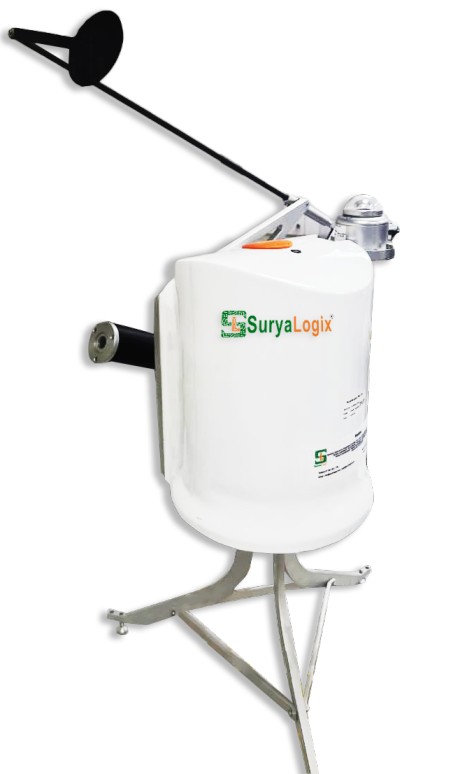
Why Choose SuryaLogix HelioTrack?
- High-accuracy automatic dual-axis sun tracking
- Simultaneous measurement of DNI and DHI
- Helps determine GHI and sunshine duration
- Class A pyrheliometer and Class A pyranometer configuration
- Automatic and optional manual tracking modes
- Integrated GPS for location, date and time synchronization
- Modbus RTU RS-485 and Modbus TCP/IP communication
- Seamless integration with SCADA and WMS platforms
Specification & Features
- Payload : 1 pyrheliometer + 1 Pyranometer
- Supply Voltage : 22 - 24 VDC
- Protection : IP65
- Internal Storage : 8 GB (Expandable)
- Weight : Approx. 10 Kg
- Installation : Plug 7 Play
- Sun Tracking Mode : Automatic / manual
- Restart After Power Failure Automatic
- GPS : Available
Frequently Asked Questions (FAQs) About Helio Track
HelioTrack is a two-axis automatic solar tracking system designed for precise sun tracking and solar irradiance measurement. It supports pyrheliometer and pyranometer integration for accurate solar resource monitoring.
Direct Normal Irradiance (DNI) is the direct solar radiation received on a surface perpendicular to the sun’s rays. It is measured in W/m² using a pyrheliometer.
GHI measures total irradiance on a horizontal surface, DNI measures direct irradiance normal to the sun, and DHI measures diffuse horizontal irradiance. Together, they define the solar resource at a site.
Automatic sun tracking continuously aligns instruments such as pyrheliometers with the sun. This reduces alignment errors and improves the accuracy and consistency of DNI measurements throughout the day.
DNI provides accurate information about direct solar radiation and is essential for detailed solar resource assessment. It supports performance analysis and is especially important for concentrating solar technologies.
GHI in solar represents the total sunlight reaching a horizontal surface from direct and diffuse sources. It is a key parameter for PV system design, energy yield estimation, and performance analysis.
Diffuse Horizontal Irradiance (DHI) is solar radiation received on a horizontal surface after being scattered by the atmosphere. It excludes radiation received directly from the sun.
A pyranometer measures hemispherical solar irradiance such as GHI or POA, while a pyrheliometer measures only DNI. A pyrheliometer requires accurate sun tracking for reliable measurement.