
Cloud Cover Sensor - PCCD
Measure the Cloud Cover Factor (CCF) for accurate sky condition monitoring in solar power plants.
Sensors
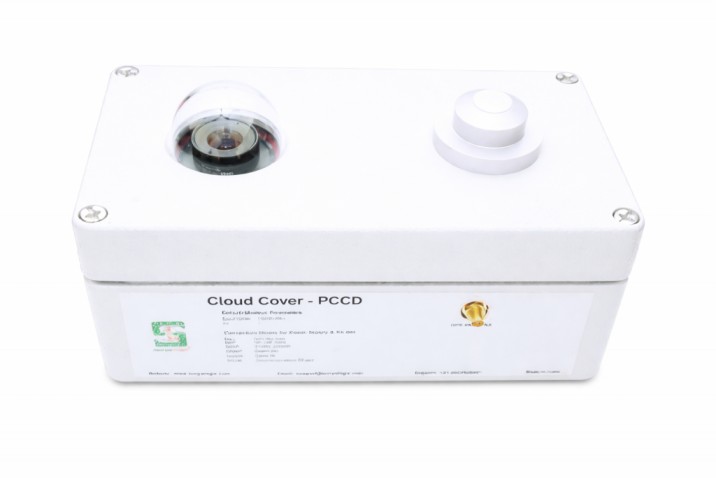
SuryaLogix Cloud Cover Sensor for Solar Power Plants
Continuous day and night cloud cover measurement for reliable weather monitoring and renewable plant performance analysis.
The SuryaLogix Cloud Cover (CC-PCCD) measures the percentage of the sky covered by clouds from 0 to 100% Cloud Cover Factor (CCF). It provides continuous cloud cover monitoring for solar power plants, weather stations, airports and environmental sites.
During the daytime, the cloud cover observes the sky in four directions using the solar spectrum. At night, it uses thermal infrared sensing to detect cloud conditions. An integrated microcomputer evaluates the signals and provides data in CCF or Okta.
The SuryaLogix Cloud Cover supports RS-485 and TCP/IP Ethernet communication for integration with SCADA, data loggers and Weather Monitoring Systems. An optional 0–10 V analog output is also available.
Why Choose Cloud Cover Sensor - PCCD?
- Continuous 24×7 cloud cover monitoring
- Reliable daytime and nighttime cloud detection
- Measures cloud cover from 0 to 100% CCF
- Provides measurement data in CCF and Okta
- Seamless integration with SCADA and WMS
- RS-485 surge protection up to 6 kV
- Multiple digital and optional analog outputs
- Suitable for solar plants and weather stations
- 5-year warranty
Specification & Features
- Day and night dual-mode sensing
- Four-direction daytime sky observation
- Thermal infrared nighttime detection
- 0–100% cloud cover measurement range
- TCP/IP Ethernet connectivity with RJ-45
- Optional 0–10 V analog output
- 12–24 V DC power supply
- Operating temperature range from -40°C to +85°C
Frequently Asked Questions (FAQs) About Cloud Cover - PCCD
Cloud cover is measured as the percentage of the sky covered by clouds using sensors, sky cameras, or satellite data. Automated sensors provide real-time cloud cover data for solar monitoring.
Clouds reflect, absorb, and scatter sunlight, reducing the solar radiation reaching the ground. Higher cloud cover generally results in lower solar irradiance.
Cloud cover is the portion of the sky covered by clouds at a particular location and time. It is commonly expressed as a percentage (%) or in oktas.
An 80% chance of rain means there is an 80% probability of measurable rainfall at a location during the forecast period. It does not mean it will rain for 80% of the time.
Cloud cover reduces the solar radiation reaching PV modules, which can decrease power generation. Real-time cloud monitoring helps analyze and forecast these variations.
SuryaLogix PCCD (Percentage Cloud Cover Detection) Sensor measures cloud cover from 0–100% CCF. It provides real-time cloud data for solar monitoring, weather analysis, and PV generation forecasting.
Cloud cover percentage is calculated by comparing the cloud-covered portion of the sky with the total visible sky area. Automated sensors can continuously calculate cloud coverage in real time.
Cloud cover indicates how much of the sky is covered by clouds, while cloud density refers to cloud thickness or opacity. Both can influence solar irradiance and PV generation.