
irradiation Sensors
Robust and reliable solution for measuring solar irradiance
Sensors
Solar Irradiation Sensors
The Irradiance sensor also referred to as a photovoltaic pyranometer, has emerged as a derivative of pyranometers with the development of photovoltaic systems. Its purpose is to measure the irradiance value from the sun. What sets irradiance sensors apart is their cost-effectiveness and low maintenance requirements.
Solar radiation on Earth is commonly characterized as the overall radiation encompassing wavelengths from 280 to 4000 nm, which is known as shortwave radiation. The total solar radiation, whether it’s in the form of a direct beam or diffuse radiation, received on a horizontal surface is referred to as global shortwave radiation or shortwave irradiance, and it is measured in watts per square meter.
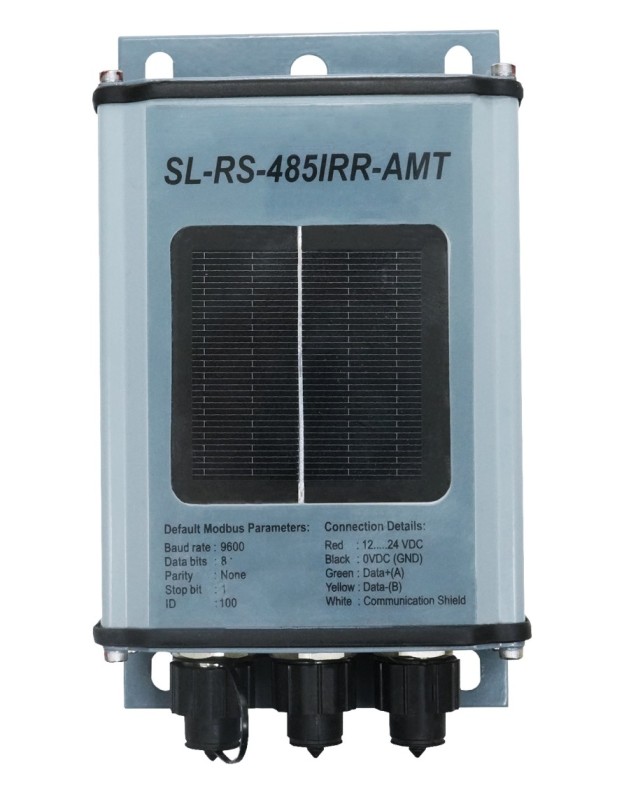
Why choose SuryaLogix Irradiation Sensor?
- Used to measure Solar Radiation flux density
- Available in both Analog and Digital output.
- Housing / Enclosure: UV-resistant PVC plastic
- Ingress Protection (IP): IP65 with both plugs securely attached.
- Reading helps in calculating the Performance Ratio of the plant
Specifications & Features
- Output: RS-485 Based
- Supply Voltage: 12 to 28Vdc
- Measuring Range: 0 to 1600 W/m²
The Irradiance sensor operates based on the Thermoelectric Effect, where sunlight absorbed by the sensor is converted into heat. This heat then transfers through the sensor to the housing of the device. By utilizing the principle that the short circuit current is directly proportional to the radiation received, the Irradiance sensor effectively measures the radiation and presents it in the form of voltage or current.
To serve as an Irradiance sensor, a monocrystalline solar cell is employed in our sensors. This solar cell is connected to a shunt, which functions alongside the low circuit. The measurement signal from the cell’s short circuit current, as well as the resistance of the temperature sensor, is processed by a microcontroller.
Frequently Asked Questions (FAQs) About Solar Irradiance sensor
Solar irradiance is the solar power received on a surface per unit area. It is measured in W/m².
Solar irradiance is measured in watts per square meter (W/m²).
Solar radiation is commonly measured in Wh/m² or kWh/m², while instantaneous irradiance is measured in W/m².
Irradiance is measured using a pyranometer or irradiance sensor that detects incoming solar energy.
Temperature compensation helps reduce measurement errors caused by changes in sensor temperature.
GHI measures irradiance on a horizontal surface, while POA measures irradiance on the tilted PV module plane.
Solar power can be estimated by multiplying irradiance by panel area and system efficiency.
An irradiance sensor converts incoming sunlight into an electrical signal for real-time solar monitoring.